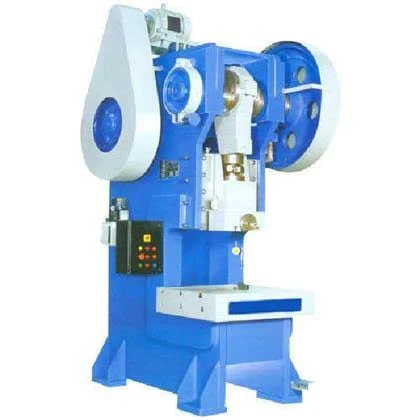
Power press machines are essential industrial tools used to cut, bend, and shape metal sheets or workpieces into specific dimensions. This is achieved by applying high amounts of pressure through a synchronized punch and die mechanism. They are widely used across the automotive, fabrication, and appliance manufacturing industries.
How it Works
The fundamental working principle revolves around converting circular, rotational motion into powerful, linear, vertical motion. An electric motor spins a heavy flywheel, which continuously accumulates and stores kinetic energy. When the operator engages the clutch, this rotational energy is transferred to a crankshaft (or eccentric gear). The crankshaft then drives the ram (the primary sliding assembly) downward with immense force and speed. The ram presses the material against the stationary bed, completing the punch or forming action before retracting to its starting position.
Types Based on Drive Mechanism
- Mechanical Presses: Powered by a flywheel and crankshaft. These operate at very high speeds, making them highly efficient for mass production and rapid stamping.
- Hydraulic Presses: Operate using pressurized hydraulic oil or water to move the piston and ram. They provide sustained force, making them ideal for heavy-duty tasks like deep drawing.
- Pneumatic Presses: Driven by compressed air. They are typically used for lighter, rapid-cycle, and high-precision operations.
- Servo-electric Presses: Utilize high-precision servo motors. They offer exact, programmable control over the ram's positioning, speed, and force.