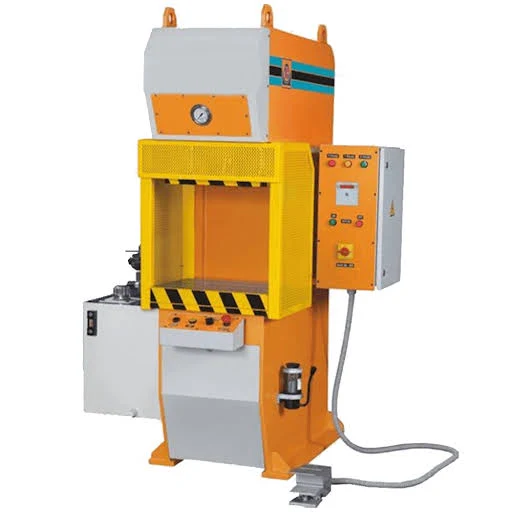
Heavy-duty hydraulic power presses are essential commercial machines used for metal forming, deep drawing, molding, and material compaction. By leveraging Pascal’s Law, they convert fluid pressure into immense, uniform compressive force. These machines are highly favored in manufacturing for their precision, repeatability, and overload protection.
Key Specifications & Operational Details
- Force & Tonnage Capacity: Commercial power presses typically deliver anywhere from 30 to 500+ tons of nominal force, depending on the framework and the intended industrial application.
- Framework Types:
- H-Frame (4-Post): Ideal for heavy-duty jobs like forging, stamping, and deep drawing. They offer structural stability, precise platen alignment, and four-sided access.
- C-Frame: Workhorse machines utilized for general tasks such as bending, punching, and straightening. They provide a lighter, versatile, and space-efficient footprint
- Working Principle: The hydraulic system utilizes a high-pressure pump to force hydraulic oil (fluid) into the cylinder, moving the piston and ram downward against a workpiece. The pressure is sustained throughout the operation, ensuring high accuracy.
- Drive & Control: Most modern commercial presses integrate digital Programmable Logic Controllers (PLCs) with touchscreen interfaces, allowing for programmable tonnage, stroke length, and automated multi-cycle operation.
- Power Source: Typically run on industrial 3-phase electricity (440V) and are equipped with powerful electric motors (e.g., 5 HP to 30 HP) to drive the main hydraulic pump.
- Material & Construction: Built with heavy-duty Mild Steel (MS) weldment, engineered to resist structural stretch or deflection under maximum tonnage.